Faculty Profile
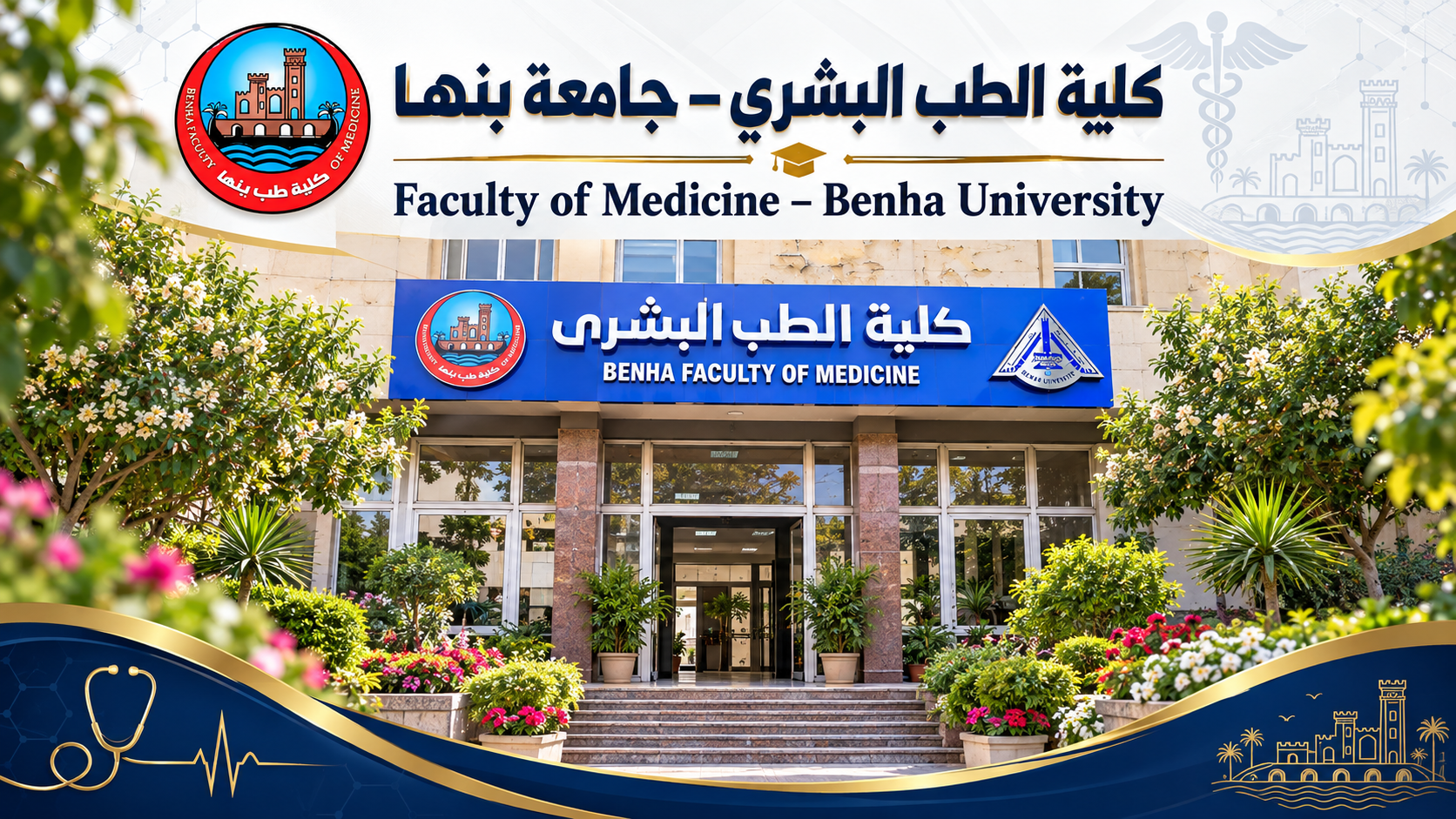
Faculty of Medicine Benha University
Institutional profile and development overview
The Faculty of Medicine at Benha University is one of Egypt’s long-established institutions within the national medical education system. It was established by Presidential Decree No. 1143, issued on 25 January 1976, to contribute to the preparation of qualified medical professionals, community service, and the advancement of healthcare development in Egypt. In terms of its date of establishment, Benha Faculty of Medicine ranks as the ninth oldest medical school in Egypt.
Since its establishment, the Faculty has undergone continuous development in medical education, scientific research, healthcare delivery, and community service. This progress has been driven by the sustained efforts of successive generations of faculty members, administrative staff, and graduates, while keeping pace with the rapid advances in medical sciences and modern technology.
Establishment and Development of Medical Education
Undergraduate education at the Faculty commenced during the 1977/1978 academic year with fourth-year students. At that time, students from Qalyubia Governorate and neighboring governorates were permitted to transfer from other medical schools. The undergraduate transfer system continued until teaching had been introduced across all academic years by 1984/1985.
In the 1981/1982 academic year, the Faculty admitted its first cohort of 50 first-year students. This marked the beginning of a new phase in the Faculty’s development toward establishing a fully integrated medical education system. By 2026, undergraduate enrollment had reached 3,556 students.
With the continued growth in student numbers and the development of the medical education system, the Faculty now serves a substantial number of undergraduate and postgraduate students. It has also educated successive generations of physicians who work across various healthcare sectors in Egypt and abroad.
As part of its efforts to modernize medical education and introduce new educational pathways—particularly integrated medical education—the Supreme Council of Universities approved the Faculty’s distinguished credit-hour program at Benha University’s Obour Campus. The program was launched in the 2025 academic year with an initial intake of 120 students. It aims to provide a contemporary educational model based on the credit-hour system and aligned with the requirements of modern medical education.
Development of Educational and Medical Facilities
Clinical training for medical students began at Benha University Hospital in conjunction with the establishment and development of the medical and educational facilities that subsequently became part of the Benha University Hospitals system.
In 1981, the first hospital building was constructed. Now known as the Ophthalmology Hospital Building, it originally accommodated the clinical departments and outpatient clinics.
In 1987, the Emergency Hospital Building and the Surgical Hospital Building were established. The Internal Medicine Hospital Building was subsequently constructed in 1993, alongside the continuous development of the Faculty’s educational facilities.
The main Faculty building was completed in 1982. This was followed by significant expansions to its educational infrastructure, including the construction of the first large lecture hall in 1994, with a capacity of approximately 500 students. The hall was officially inaugurated in 1998. A second large lecture hall was later constructed above the first and inaugurated in 2000.
Future Expansion
To accommodate the steady increase in student enrollment, Benha University has allocated a plot of land in the Kafr Saad area as an extension of the Faculty’s existing premises.
Academic and Educational Departments
The Faculty of Medicine at Benha University currently comprises 33 academic, basic medical science, and clinical departments covering a broad range of medical disciplines. These departments contribute to undergraduate medical education, postgraduate studies, and scientific research.
The Faculty also offers postgraduate programs leading to diploma, master’s, and doctoral degrees in various medical specialties, in addition to academic courses and scientific and research training programs.
Educational and Scientific Resources
The Faculty houses a range of facilities and resources that support its educational and research activities. The most notable of these include:
Faculty Council Meeting Hall
Located on the seventh floor, the hall is equipped with audiovisual systems and facilities suitable for official meetings and academic events.
Seminar and workshop Hall
Adjacent to the Faculty Council Meeting Hall, this venue has a seating capacity of approximately 112 and is equipped with display screens and an audio system. It is used for seminars, thesis defenses, scientific discussions, and academic events.
Faculty Library
Located on the eighth floor, the library provides internet access, computer facilities, and photocopying services. Its collections include Arabic and international scientific references and periodicals. It also provides access to databases, electronic resources, and the Egyptian Knowledge Bank.
Main Examination Hall
Located on the ground floor, this air-conditioned hall has a capacity of approximately 350 students and was inaugurated in 1999.
Medical Education Center
Located on the seventh floor, the Medical Education Center is equipped with modern educational, audiovisual, and lighting technologies. It was inaugurated in 2003 to support the development of medical teaching and training methods.
The Faculty also includes several units and centers that support education and research, including the Quality Assurance Unit, Information Technology Unit, Measurement and Evaluation Unit, Strategic Planning Unit, Graduate Follow-up Unit, and the Scientific Laboratories and Equipment Unit, which includes facilities such as the Electron Microscopy Unit. These are complemented by several specialized laboratories and research units.
Benha University Hospitals
Benha University Hospitals constitute the principal clinical, training, and research arm of the Faculty of Medicine. They play a pivotal role in delivering medical and therapeutic services, providing clinical training for medical students, physicians, and junior academic staff, and supporting scientific research.
The hospital system comprises numerous clinical departments and specialized medical units covering a wide range of disciplines. This enables the provision of integrated diagnostic and therapeutic services to patients from Qalyubia Governorate and neighboring governorates.
The major specialized units and services established within the University Hospitals include:
-
Hemodialysis Unit.
-
Bronchoscopy, Pulmonary Function Testing, and Allergy Unit.
-
Gastrointestinal Endoscopy Unit.
-
Laparoscopic Surgery Units.
-
Gynecological Laparoscopic Surgery Unit.
-
Human Reproduction and In Vitro Fertilization Unit.
-
Molecular Biology Unit.
-
Clinical Toxicology Unit.
-
Pediatric Cardiology Unit.
-
Gastrointestinal and Abdominal Laparoscopic Surgery Unit.
-
Clinical Immunology Unit.
-
Endocrine Chemistry Unit.
-
Radiology and Medical Imaging Units, including closed-bore magnetic resonance imaging and multislice computed tomography.
-
Intensive Care and Critical Care Units.
-
Cardiac Catheterization Unit.
-
Cardiothoracic surgery services and other highly specialized medical services.
Recent Development of the University Hospitals
Since the 1990s, Benha University Hospitals have undergone continuous expansion in the provision of advanced medical services. In 1994, the Department of Cardiac Surgery commenced operations, alongside the introduction of computed tomography services.
In 1996, the Critical Care Unit was inaugurated with 36 intensive care beds equipped with patient-monitoring systems and mechanical ventilators. This development also included cardiac intensive care and intermediate care units.
The Cardiac Catheterization Unit was inaugurated in 1997, followed by the opening of an advanced open-heart surgery suite in 2002.
Over time, the hospital system expanded to provide highly specialized medical services, strengthening the role of Benha University Hospitals in advanced healthcare delivery, medical education, clinical training, and scientific research.
Recent years have also witnessed the implementation of major projects to upgrade the infrastructure and medical services of Benha University Hospitals.
One of the most significant projects was the comprehensive redevelopment of the Surgical Hospital, which was inaugurated in June 2025 at an estimated cost of EGP 350 million. The project included upgrading the building and increasing its capacity from approximately 135 beds to 216 beds. This capacity comprises 208 inpatient beds distributed across 52 rooms, in addition to single negative-pressure isolation rooms and dedicated facilities for intensive care, postoperative recovery, surgery, endoscopy, radiology, laboratories, and sterilization.
The redevelopment represents a major addition to the University’s educational and clinical system. It also included the modernization of academic spaces and teaching halls allocated to the surgical departments.
Several strategic projects are also under implementation, including the new Benha University Hospital, the Outpatient Clinics and Specialized Medical Centers Project, and the Radiotherapy and Oncology Center. These projects are being undertaken alongside plans to develop and improve the efficiency of several existing medical facilities.
The University Hospitals currently have a total capacity of approximately 1,047 beds, including 168 critical care beds. Seventeen modular operating theatres equipped with advanced capsule systems have also been inaugurated.
The hospitals participate in national healthcare initiatives and organize medical outreach convoys that benefit villages and cities throughout Qalyubia Governorate, reflecting the growing scope of their role in healthcare delivery and community service.
Ongoing development projects include the new Benha University Hospital, with an estimated cost of approximately EGP 3 billion; the Outpatient Clinics and Specialized Medical Centers Project, with an estimated cost of approximately EGP 420 million; and the Radiotherapy and Oncology Center, with an estimated construction cost of approximately EGP 95 million. Further plans include the redevelopment of the Internal Medicine Hospital and improvements to the reception and emergency care system.
An Integrated System of Education Scientific Research and Healthcare
Nearly five decades after its establishment, the Faculty of Medicine at Benha University has become a major component of the medical education and healthcare systems serving Qalyubia Governorate and the wider Nile Delta region.
The Faculty and its University Hospitals operate through three interconnected pillars:
Medical Education
The Faculty educates and prepares medical students both academically and clinically, develops modern methods of medical teaching, and provides contemporary educational pathways, including the credit-hour program.
Scientific Research and Postgraduate Studies
The Faculty prepares physicians and researchers through diploma, master’s, and doctoral programs while supporting research projects across a wide range of medical specialties.
Healthcare and Community Service
The Faculty and its University Hospitals provide integrated and specialized medical services to the residents of Qalyubia and neighboring governorates. They also participate in national healthcare initiatives, medical outreach convoys, and national projects aimed at improving healthcare services.
The Faculty of Medicine at Benha University therefore continues the journey it began in 1976, evolving from a newly established medical school into an integrated academic and healthcare institution. Today, it brings together medical education, scientific research, and healthcare delivery while keeping pace with rapid developments in medicine, technology, and healthcare. The Faculty remains committed to the continuous development of its educational and medical infrastructure in order to meet present and future needs.